
Virtual inspection services
What a remote inspection covers, what it honestly cannot, and exactly how one runs, live and offline.
What can be inspected remotely
Remote inspection works on work that is visible, reachable and methodical. These are the categories where it is already routine, and where state legislatures are moving to make it the norm:
- HVAC changeouts, heat pump installations and heat pump water heaters
- Water heater replacements
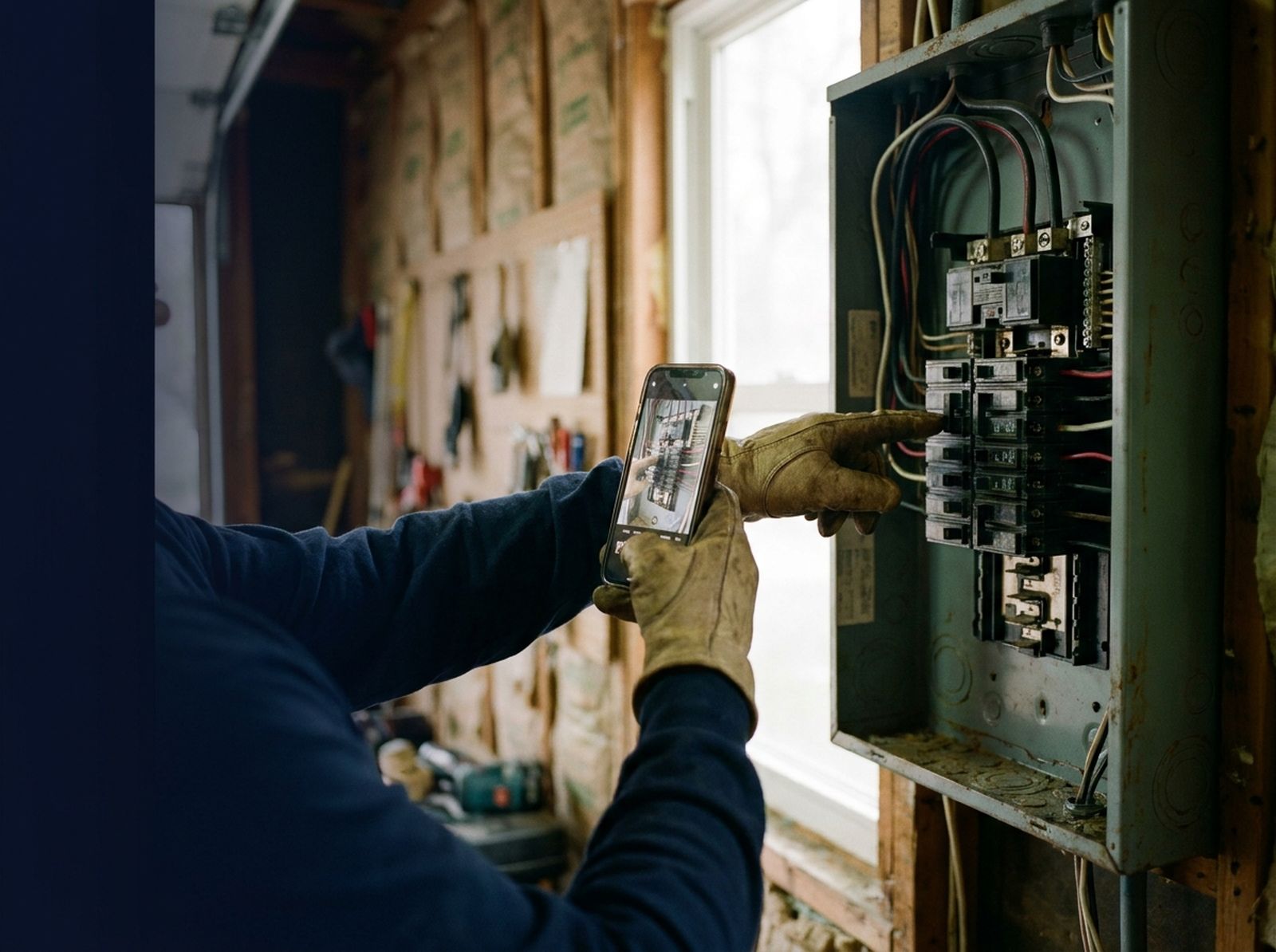
- Electrical service and panel upgrades
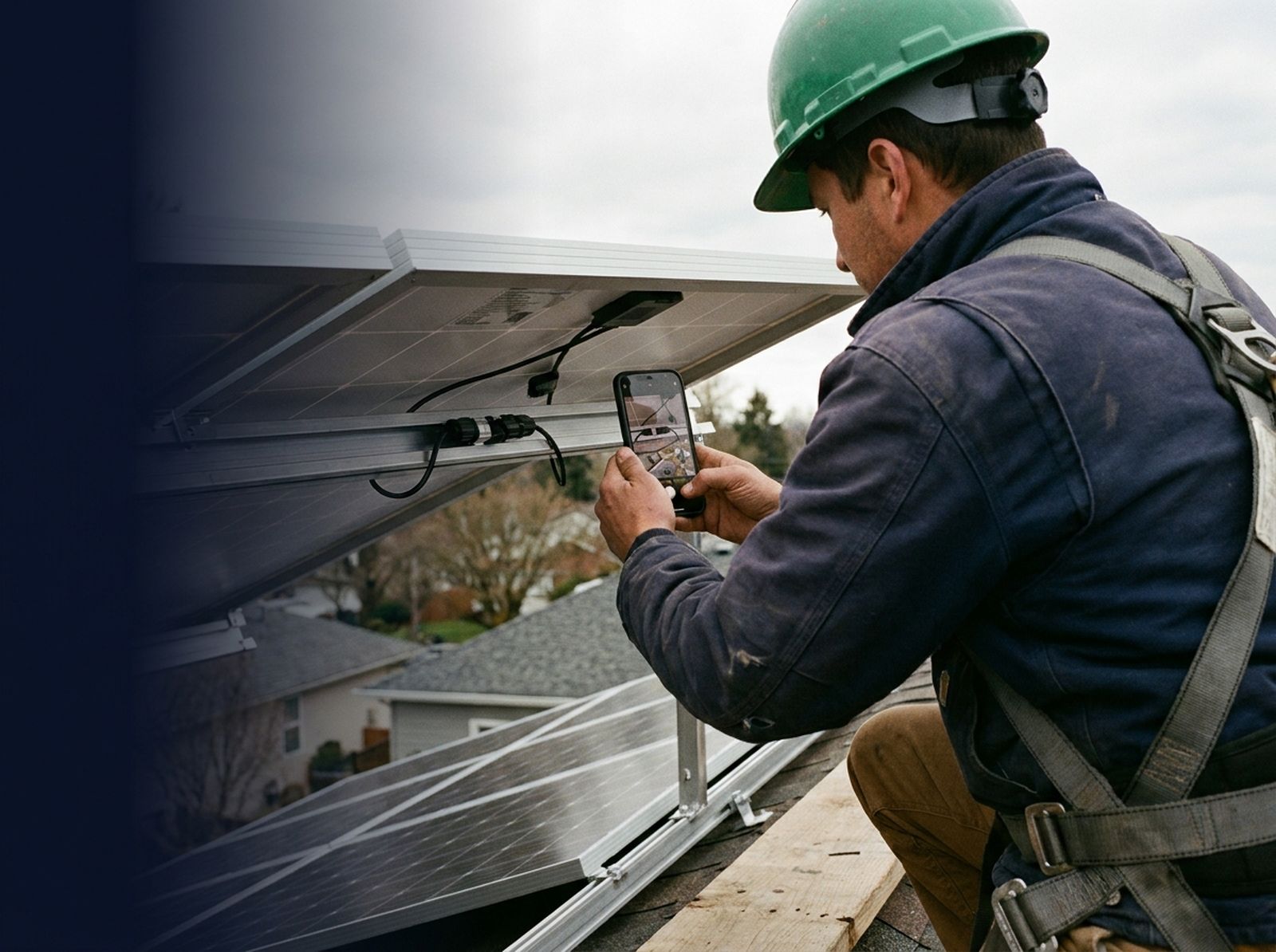
- Residential and rooftop solar installations
- Rough and final checks on residential permit work
- Progress inspections and code-compliance walkthroughs
- Gauge and instrument readings you can hold a camera on, including pressure gauges
- Data plates, equipment labels, panel schedules, model and serial numbers
- Correction sign-offs and re-inspections after a failed item is corrected
- Footings, rebar and trench work before a pour or a backfill
- Insulation, sheathing and nailing patterns before they are covered
- Work that finishes after hours or on the weekend, filed offline and reviewed the next business day
Not sure your job fits a category? Describe it. The answer takes us two minutes and costs you nothing.
What cannot be done remotely
This list matters more than the one above, so we keep it to what is actually true. Three categories, not a list of tools.
- Work that has to be handled. If the inspector has to physically manipulate, disturb or force-test the work themselves, a camera cannot stand in for their hands. Reading an instrument is not the same thing as operating one.
- Work that cannot be seen or reached. Already behind drywall, insulation or finishes, or not safely accessible. No camera angle changes that. It needed inspecting before it was covered.
- Anything your building department requires in person. Their rule wins, every time, and we tell you when it applies.
There is a fourth honest case. Your inspector can stop a remote inspection partway through and require an in-person one if what they can see is not enough to judge compliance. The ICC's own guidance says they should. So do we. If we start your virtual inspection and cannot complete it remotely, there is no charge for the inspection.
Things people assume we cannot do
- Read a pressure gauge. You hold the camera on it. This is one of the better uses of a remote inspection, not a limit of one.
- Work in a dark mechanical closet. Your inspector switches on your phone's flashlight from their side of the call.
- Inspect job sites with a bad signal. The session drops to still capture over a voice call, or you file it offline instead.
- Work that finishes at seven on a Friday evening. An offline report has no appointment to keep.
How an inspection runs
There are two methods. Live is a scheduled video call. Offline has no call at all. Which one suits a job depends on the work, the site and the clock.
Live, on a call
Before the call
You request the inspection from your account and send anything relevant with it: permit number, plans, photos. Your inspector reviews it, so the call starts informed rather than cold.
Your inspector texts you
Near the scheduled time your inspector sends a text message with a link. You do not start the inspection and the link does not arrive in advance. Wait for the text.
Tap the link
It opens in your phone's browser. Nothing to install, no account, no password. Allow camera, microphone and location. Those permissions are temporary and end when the call ends.
The walkthrough
Your inspector sees what your camera sees and directs you: where to stand, where to point, what to hold steady on. They can switch on your flashlight, and they take the captures themselves using your camera. Nothing is saved to your phone, and they cannot see or copy anything else on it.
Witnesses, if you want them
Your inspector can invite other phone numbers or email addresses onto the same call, so a project manager or an owner can watch without driving out to the site.
The verdict, then the report
Your inspector tells you on the call what passed, what needs correction and what happens next, in plain language. The written report follows, backed by the captures taken during the call.
On a weak signal the session switches to still capture: you send photos while you talk on an ordinary voice call. Either way it is light on data usage, around 12 to 20 MB for five minutes of video.
Offline, through the app
Your site representative gets certified
Offline reports are captured by your people, not ours, so Building Code Guru certifies your site representative on the submittal process first. That is online training, then one sample offline inspection that has to meet the submittal criteria. It is what makes an offline report complete the first time it arrives.
Install the app
VuSpex GO, on iOS or Android. This is the one part of the service that needs an app installed. A live call never does.
Capture on site
Photos and video taken with the app itself, so every file carries verified GPS from the site. Pictures taken on your normal camera and imported afterwards do not carry it. We provide the checklist of what photos and videos you need to submit for your inspection. Up to 15 photos and 10 videos, each video up to 15 seconds.
Describe it
A comment on the media, a description of the work, then the agency, the permit and the inspection type.
Save, then send
Saving locks the report so it cannot be edited afterwards. Capture itself needs no connectivity at all, so send it whenever you next have wifi or a signal.
Your inspector reviews it
Your inspector reviews the submitted report on their own schedule and issues the result. You get a text and an email confirming it arrived, then the result once it has been reviewed.
Offline suits work that finishes after hours or on the weekend, sites with no usable signal, and anything where holding an appointment costs more than it saves. There is no scheduled call to keep.
What you need on site
A smartphone
Any reasonably recent phone with a working camera. A live inspection runs in the browser with nothing to download. An offline report needs the VuSpex GO app installed once.
A signal, or none at all
A live call needs a connection and handles a weak one. An offline report needs no connection while you capture: it uploads when the signal returns.
Access to the work
The work being inspected has to be visible and reachable. If a ladder or a panel key is needed to see it, have it there.
Whoever holds the camera needs to be at least 18, able to talk with the inspector throughout, and willing to agree to the consent notice at the start of the call. That is the ICC's recommendation and we follow it.
Codes we inspect against, and how this works with your department
Every job we take is a building code inspection at heart. Our team holds 39 ICC certifications and inspects against the International Codes as adopted by your jurisdiction, including its local amendments. Building, electrical, plumbing, mechanical and energy work are all covered within the team's certifications. A remote inspection is meant to reach the same result as an in-person one, and it is held to the same standard. See the full list.
Whether an inspection can be done remotely is the building department's decision, not ours. The ICC's Recommended Practices for Remote Virtual Inspections, published in 2020 and carried as Resource A in the 2021 International Building Code, puts it plainly: the determination is at the sole discretion of the authority having jurisdiction.
The same guidance says that, subject to local approval, the authority may use an approved third party inspection agency rather than its own staff. That is where we fit. Section 104.4 of the 2021 IBC gives the building official the authority to accept reports of inspection by approved agencies, and section 1704.2.1 requires an approved agency to give the building official written documentation of its inspectors' competence, experience and training. Our certifications are that documentation, and we supply them.
The ICC guidance covers the offline route directly too. It says some authorities may consider allowing the contractor to provide acceptable electronic documentation of the area needing inspection, for review by the assigned inspector. That is exactly what an offline field report is.
Tell us where the project is and which department holds the permit. We will give you a straight answer on whether they accept this before you sign anything.
Questions people actually ask
What is a virtual inspection, in plain terms?
A building inspection carried out remotely instead of in person, in one of two ways. Live: you point a phone camera at the work while a certified inspector examines it in real time, directs the walkthrough and captures the evidence. Offline: a certified site representative captures photos and video of the work in the inspection app, and the inspector reviews the submitted report and issues the result. You will also hear it called a remote visual inspection, a remote video inspection, or RVI. Same thing.
What is the difference between a live inspection and an offline one?
A live inspection is a scheduled video call. Your inspector texts you a link near the agreed time, sees the work through your camera, directs you and captures the evidence themselves. An offline inspection has no call. Your certified site representative captures photos and video in the app, with GPS verification, and files the report. Your inspector reviews it on their own schedule and issues the result. Live suits anything that needs a conversation or a judgment call in the moment. Offline suits work that finishes outside inspection hours, or a site with no usable signal.
How do I prepare for a virtual inspection?
Three things: a charged smartphone, access to the work, and anything that helps us see it, like a ladder or a panel key. Have your permit card and approved plans handy for the inspection along with any other documents required by your local building department. Your inspector directs everything else on the call, so there is nothing to rehearse. If it is an offline report, install the app before you get on site and have the permit and inspection documents on hand.
How long does a virtual inspection take?
It depends on the scope. A single-system check like a water heater replacement is a short call. A multi-trade walkthrough takes longer. Your contract sets out what is covered, and we tell you how long to set aside for each inspection type.
Do building departments accept virtual inspections?
Increasingly, yes. Building departments across the US run virtual inspections every day, and the ICC has published recommended practices for them, carried in the 2021 International Building Code. Acceptance is still the local department's decision in almost every case. California's Assembly Bill 1738 would change that in one state: it would require qualifying cities and counties to offer remote inspections by July 1, 2028, for a defined list of works on one and two family homes such as heat pump water heaters, heat pump HVAC, reroofs, solar under 15 kW, and smoke and carbon monoxide alarms. Smaller jurisdictions are exempt. The legislature passed it in August 2026 and it went to the Governor on August 28; it is not law unless it is signed. Tell us where the project is and we will confirm your department's position before you sign anything.
What if I am not sure my inspection can be done remotely?
Send the details through the contact form. We will tell you plainly whether it suits a remote inspection, and if it does not, we will say so and you will have lost nothing but the time it took to ask.
Is the whole call recorded?
No. The call is not recorded end to end. What is captured is segments: photos and short video clips of the work, taken at the moment your inspector examines it. Those captures are timestamped and stored with your inspection record, and they are what documents the work that was approved and the work that needs correction. Nothing is saved to your phone. More on how the platform works.
What does it cost?
Pricing is set in your contract, agreed before any inspection is booked, and it depends on inspection type and volume. Ask for a demo first, watch the process run, then we price it.

Describe the job, get a straight answer
We reply within one business day, including when the answer is "this one needs an in-person inspector".
Request a demoOr email inspexgurus@